Drift of spectrally stable shifted states on star graphs
Adilbek Kairzhan, Dmitry Pelinovsky, and Roy Goodman. SIAM Journal on Applied Dynamical Systems, 2019.


Abstract
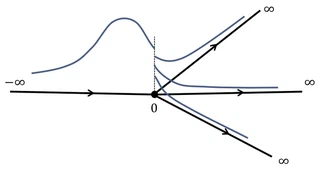
When the coefficients of the cubic terms match the coefficients in the boundary conditions at a vertex of a star graph and satisfy a certain constraint, the nonlinear Schrödinger (NLS) equation on the star graph can be transformed to the NLS equation on a real line. Such balanced star graphs have appeared in the context of reflectionless transmission of solitary waves. Steady states on such balanced star graphs can be translated along the edges with a translational parameter and are referred to as the shifted states. When the star graph has exactly one incoming edge and several outgoing edges, the steady states are spectrally stable if their monotonic tails are located on the outgoing edges. These spectrally stable states are degenerate minimizers of the action functional with the degeneracy due to the translational symmetry. Nonlinear stability of these spectrally stable states has been an open problem up to now. In this paper, we prove that these spectrally stable states are nonlinearly unstable because of the irreversible drift along the incoming edge towards the vertex of the star graph. When the shifted states reach the vertex as a result of the drift, they become saddle points of the action functional, in which case the nonlinear instability leads to their destruction. In addition to rigorous mathematical results, we use numerical simulations to illustrate the drift instability and destruction of the shifted states on the balanced star graph.
Type
Publication
SIAM Journal on Applied Dynamical Systems, 18, 1723–1755


Authors
Professor, Associate Chair for Graduate Studies, Department of Mathematical Sciences
I am a professor in the Department of Mathematical Sciences at NJIT. My research applies methods of dynamical systems to (conservative, dispersive) nonlinear wave equations arising, for example, in optics and fluid mechanics. I am interested in dynamical and bifurcation phenomena, and I use techniques from Hamiltonian mechanics and perturbation theory, as well as extensive computations. My current research in vortex dynamics is supported by the NSF under DMS-2206016.
I led the effort to start the SIAM New York-New Jersey-Pennsylvania Section (SIAM NNP) and was its first president in 2023-2024. I have handed over the reins to a new leadership group.