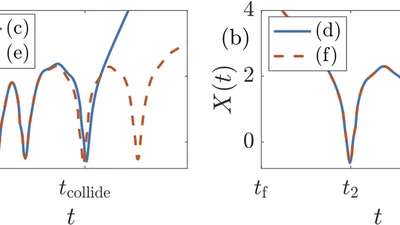
Loss of Physical Reversibility in Reversible Systems
A dynamical system is said to be reversible if, given an output, the input can always be recovered in a well-posed manner. Nevertheless, we argue that reversible systems that have …

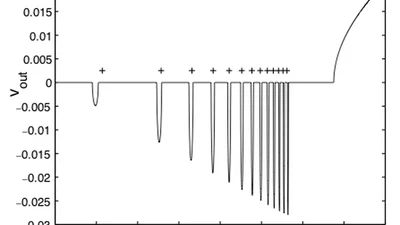
A dynamical system is said to be reversible if, given an output, the input can always be recovered in a well-posed manner. Nevertheless, we argue that reversible systems that have …
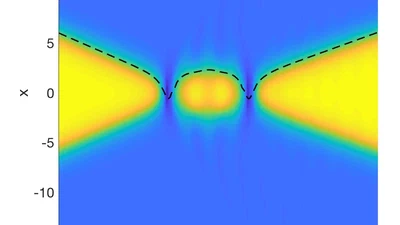
We analyze the fractal structure seen in kink-antikink collisions of the $\varphi^4$ equation. The analysis is based on qualitative ordinary differential equation models related to …

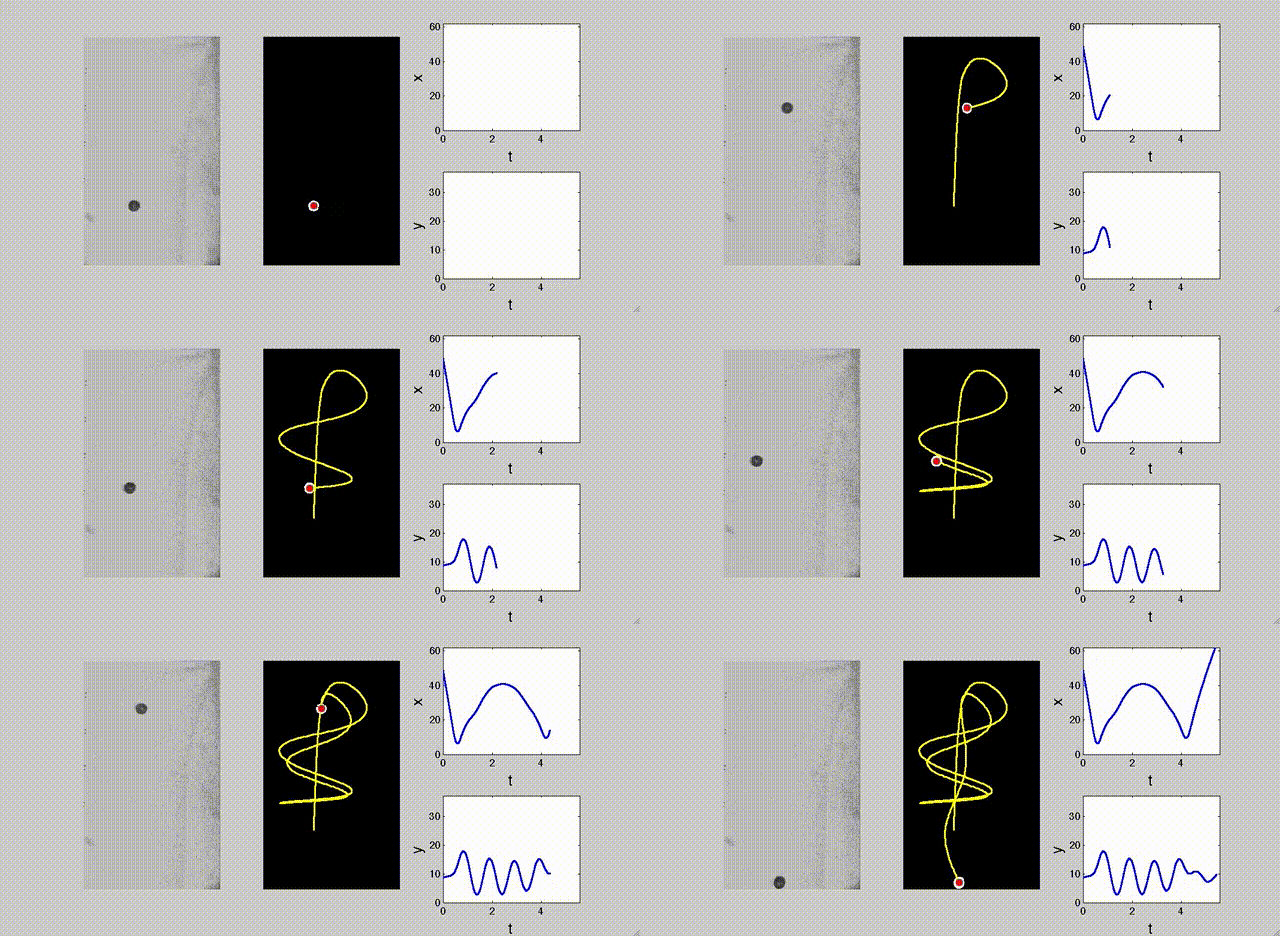
We describe a simple mechanical system, a ball rolling along a specially-designed landscape, that mimics the dynamics of a well known phenomenon, the two-bounce resonance of …
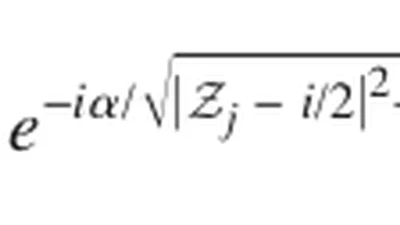
We derive a family of singular iterated maps---closely related to Poincaré maps---that describe chaotic interactions between colliding solitary waves. The chaotic behavior of such …
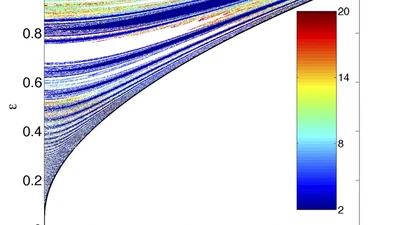
We present a new and complete analysis of the n-bounce resonance and chaotic scattering in solitary wave collisions. In these phenomena, the speed at which a wave exits a collision …
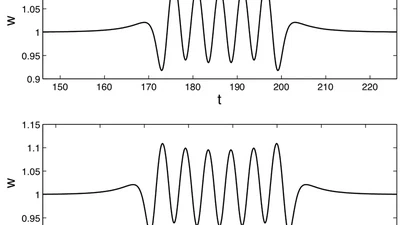
We consider the interactions of two identical, orthogonally polarized vector solitons in a nonlinear optical fiber with two polarization directions, described by a coupled pair of …
Gap solitons are localized traveling waves that exist in Bragg grating optical fibers. We demonstrate a family of grating defects that support linear and nonlinear standing wave …
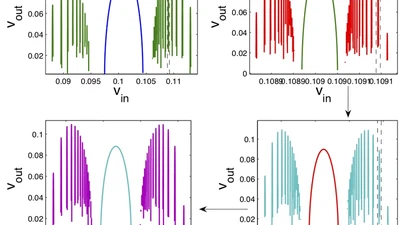
We provide a detailed mathematical explanation of a phenomenon known as the two-bounce resonance observed in collisions between kink and anti-kink traveling waves of the phi-four …
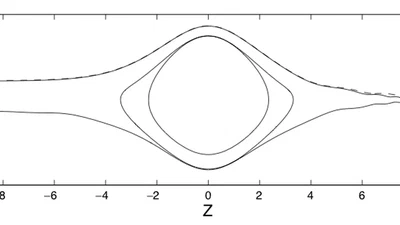
We consider the interaction of a nonlinear Schrödinger soliton with a spatially localized (point) defect in the medium through which it travels. Using numerical simulations, we …
A model of soliton--defect interactions in the sine-Gordon equations is studied using singular perturbation theory. Melnikov theory is used to derive a critical velocity for strong …